



Parasite
Antiparasitics are a class of medications which are indicated for the treatment of parasitic diseases such as nematodes, cestodes, trematodes, and infectious protozoa.
Parasite Isoform Specific Products
All Product Categories
-
Parasite Related Products (2507)
Related Products (2507)

-
Related Compound Screening Libraries (1)
-
Parasite Isoform Comparison
-
Terallethrin
 0 ImagesCat. No.: HY-118412CAS No.: 15589-31-8Synonyms: M108Terallethrin (M108) is a synthetic pyrethroid widely used as an insecticide in agricultural and household Settings.
-
G6PD-IN-2
 0 ImagesCat. No.: HY-136783CAS No.: 333311-00-5G6PD-IN-2 is a Plasmodium falciparum glucose-6-phosphate dehydrogenase (G6PD) inhibitor with an IC50 value of 0.2 μM. G6PD-IN-2 exerts weak inhibitory activity on Plasmodium falciparum glucose-6-phosphate dehydrogenase-6-phosphogluconolactonase (PfGluPho) with an IC50 value of 22.0 μM. G6PD-IN-2 inhibits growth of Plasmodium falciparum 3D7 strain and exhibits low cytotoxicity in hepatocytes. G6PD-IN-2 can be used for the research of malaria.

-
Apicidin C
 0 ImagesCat. No.: HY-177441CAS No.: 366448-28-4Apicidin C (Compound 5a) is a cyclic tetrapeptide. Apicidin C has an antiprotozoal and antimalarial activity against Eimeria tenella (IC50: 6 nM) by reversibly inhibiting HDAC acyivity. Apicidin C can be used for malaria infections research.
-
SKF-83566 (Standard)
 0 ImagesCat. No.: HY-103430ARCAS No.: 99295-33-7SKF-83566 (Standard) is the analytical standard of SKF-83566 (HY-103430A). This product is intended for research and analytical applications. SKF-83566 is an orally active, blood-brain barrier-permeable D1/D5 dopamine receptor antagonist with a Ki value of approximately 0.4-0.56 nM. SKF-83566 modulates locomotor behavior and spatial memory by blocking D1 receptors and inhibits glioblastoma progression by targeting the DRD1/c-Myc/UHRF1 pathway. SKF-83566 acts as an inhibitor of the dopamine transporter (DAT) and adenylyl cyclase 2 (AC2). SKF-83566 competitively binds to DAT to inhibit dopamine reuptake and non-competitively inhibits AC2 activity, thereby reducing cAMP accumulation. SKF-83566 is used in research areas such as dopaminergic system mechanisms, learning and memory, targeted intervention for glioblastoma, AC2 pathophysiology, antiparasitic drug screening, and synaptic plasticity (the "gating effect").
-
Antiparasitic agent-41
 0 ImagesCat. No.: HY-23312CAS No.: 101781-61-7Antiparasitic agent-41 is an orally active Antiparasitic agent. Antiparasitic agent-41 exhibits insecticidal activity against Schistosoma mansoni. Antiparasitic agent-41 can be used in the research of schistosomiasis.
-
Azlocillin (Standard)
 0 ImagesCat. No.: HY-B0529RCAS No.: 37091-66-0Azlocillin (Standard) is the analytical standard of Azlocillin. This product is intended for research and analytical applications. Azlocillin, an antibiotic, is a semisynthetic penicillin, and has broad-spectrum antibacterial activity. Azlocillin is active against drug-tolerant B. burgdorferi sensu stricto JLB31 infection.
-
MB4253
 0 ImagesCat. No.: HY-182621CAS No.: 101264-04-4MB4253 is an orally active aliphatic amide and schistosomicidal agent. MB4253 acts against Schistosoma mansoni. MB4253 can be used for the research of schistosomiasis.
-
Levamisole (Standard)
 0 ImagesSynonyms: (-)-Tetramisole (Standard)Levamisole (Standard) is the analytical standard of Levamisole. This product is intended for research and analytical applications. Levamisole ((-)-Levamisole), an anthelmintic agent with immunomodulatory properties. Levamisole acts as a positive allosteric modulator (PAM) for the α3β2 (EC50=300 μM) and α3β4 (EC50=100 μM) subtype of nAChRs. Orally active.

-
ELQ-316
 0 ImagesCat. No.: HY-171190CAS No.: 1354745-69-9ELQ-316 is an endochinlike quinolone compound and an anti-parasite agent. ELQ-316 demonstrates a great efficacy against acute and chronic experimental toxoplasmosis.
-
Isonardoperoxide
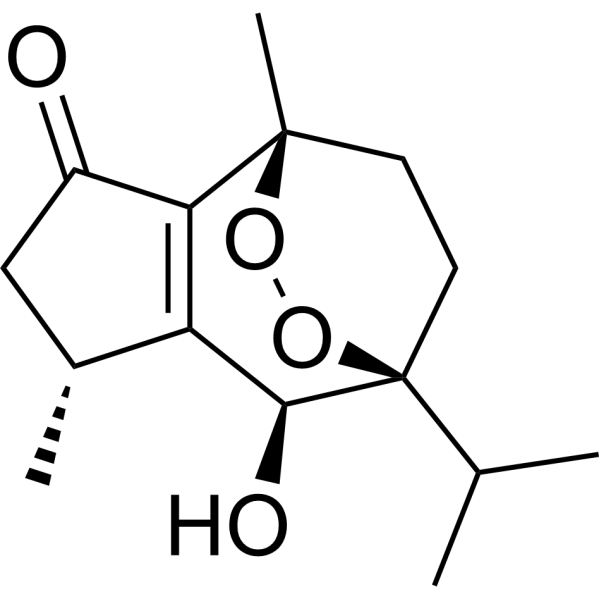 0 ImagesCat. No.: HY-126392CAS No.: 205248-65-3Isonardoperoxide is a potent antimalaria agent with an EC50 of 0.6 μM for Plasnwdium fulciparum malaria.
-
VNI
 0 ImagesCat. No.: HY-130752CAS No.: 1246770-52-4VNI is an effective inhibitor of CYP51. VNI can inhibit sterol synthesis in Trypanosoma cruzi, exhibiting anti-Trypanosoma cruzi activity.
-
Oxantel pamoate (Standard)
 0 ImagesSynonyms: Oxantel embonate (Standard)Oxantel pamoate (Standard) (Oxantel embonate (Standard)) is the analytical standard of Oxantel pamoate (HY-B1344). This product is intended for research and analytical applications. Oxantel pamoate (Oxantel embonate) is an anthelmintic agent that potently against Trichuris muris. Oxantel pamoate inhibits fumarate reductase (Frd) activity in some pathogenic bacteria and inhibits P. gingivalis homotypic biofilm formation (IC50 of 2.2 μM).
-
Doramectin monosaccharide
 0 ImagesCat. No.: HY-134220CAS No.: 165108-44-1Doramectin monosaccharide is an acid degradation product of Doramectin (HY-17035), a disaccharide-containing anthelmintic that potentiates glutamate- and GABA-gated chloride channel opening in nematodes. Doramectin undergoes acid-catalyzed hydrolysis to form doramectin monosaccharide.
-
Antitrypanosomal agent 28
 0 ImagesCat. No.: HY-180158CAS No.: 2413738-47-1Antitrypanosomal agent 28 (Compound 2a) is a trypanocidal agent. Antitrypanosomal agent 28 effectively inhibits Trypanosoma cruzi by inducing the generation of ROS and mitochondrial damage, with an IC₅₀ of 49.4 μM. Antitrypanosomal agent 28 exhibits broad-spectrum anti-tumor activity against various tumor cell lines, especially being sensitive to leukemia, colon cancer, and breast cancer. Antitrypanosomal agent 28 can be used for research on anti-cancer and anti-trypanosome activities.
-
Quinacrine dihydrochloride (Standard)
 0 ImagesCat. No.: HY-13735ARCAS No.: 69-05-6Synonyms: Mepacrine dihydrochloride (Standard); SN-390 dihydrochloride (Standard)Quinacrine (dihydrochloride) (Standard) is the analytical standard of Quinacrine (dihydrochloride). This product is intended for research and analytical applications. Quinacrine (Mepacrine) dihydrochloride is an orally bioavailable antimalarial agent, which possess anticancer effect both in vitro and vivo. Quinacrine dihydrochloride suppresses NF-κB and activate p53 signaling, which results in the induction of the apoptosis.
-
Permethrin-d6
 0 ImagesCat. No.: HY-W774926CAS No.: 82523-59-9Synonyms: NRDC-143-d6Permethrin-d6 (NRDC-143-d6) is deuterium labeled Permethrin. Permethrin (NRDC-143) is an insecticide, acaricide and a high selectively inhibitor of the Mitochondrial complex I, found in sediment and water samples. Permethrin shows estrogenic in vivo and anti-estrogenic activity in vitro. Permethrin also acts as a neurotoxin affecting neuron membranes by prolonging Sodium channel activation. Permethrin decreases resistance to bacterial infections in medaka (Oryzias latipes).
-
Pervicoside B
 0 ImagesCat. No.: HY-N7236CAS No.: 96157-95-8Pervicoside B is a glycoside C isolated from Neothyone gibbosa sea cucumber. In vitro studies have shown that Pervicoside B has a potent antiparasitic effect against Leishmania mexicana, inhibiting 100% of promastigotes at 5-10 μg/mL. Pervicoside B also exhibits strong antifungal activity against Aspergillus niger, with MIC values ranging from 4.65 to 16.7 μg/mL. Pervicoside B has potential applications in the inhibition of parasitic infections and fungal diseases.
-
BPH-1218
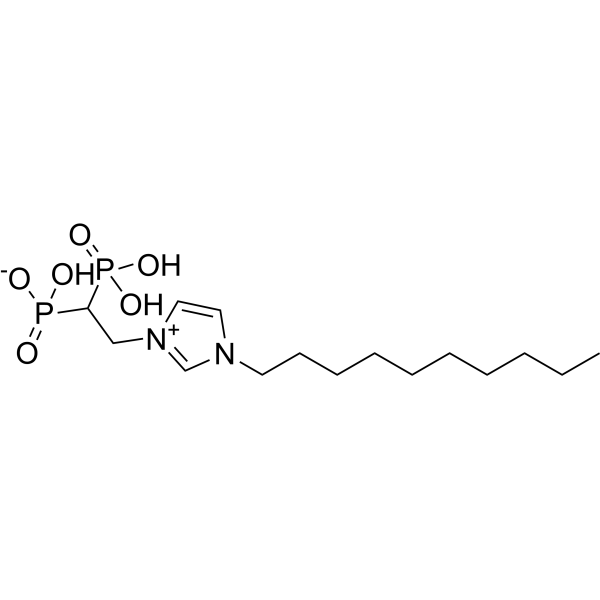 0 ImagesCat. No.: HY-135625CAS No.: 1426824-36-3BPH-1218 is an inhibitor of squalene synthase (SQS), with the IC50 of 31 nM and 64 nM for TcSQS and HsSQS, respectively, that can be used as an anti-infective agent.



